
Ancient cultures didn’t have brain scans or clinical research, so they wrapped trance states in religion and ritual. But the pattern underneath was strikingly consistent. Calm the body, focus the mind, and healing becomes easier to reach.
In ancient Egypt, sick or troubled people would visit what historians now call sleep temples. A patient would rest overnight in a quiet, dim room while a priest guided them into a relaxed, trancelike state. The belief was that the gods could send healing messages during this state, or that the body itself could begin to repair while the mind was quiet.
The Greeks had a similar tradition at temples built for Asclepius, the god of medicine. People would sleep on the temple grounds hoping for a healing dream, a process called incubation. Priests sometimes guided visitors into a relaxed state first, hoping to bring on that dream more easily.
Other cultures had their own versions of the same idea. Persian traditions used rhythmic chanting to shift a person’s state before treatment. Certain Hebrew practices combined meditation, breathing, and focused attention as part of healing rites. Indian yogic traditions relied heavily on meditation and single point concentration, an idea that later influenced how hypnosis was understood in the West. None of these traditions used the word hypnosis, but they were clearly working with the same basic tool.
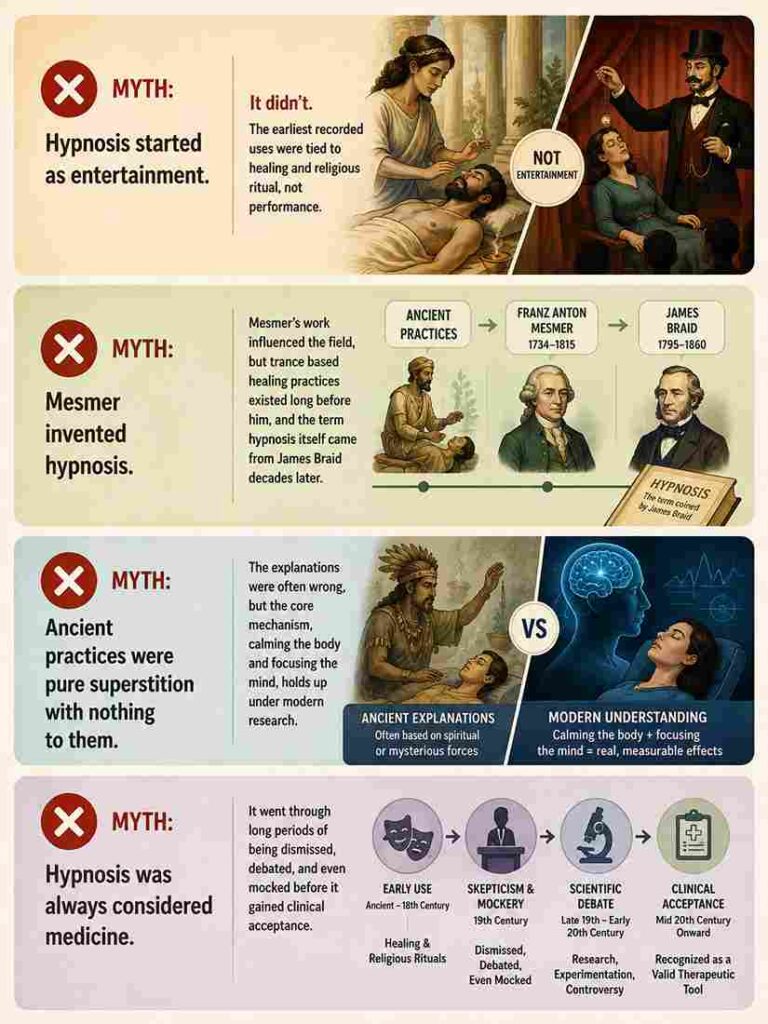
The story most people know begins with Franz Anton Mesmer, an Austrian physician working in Europe in the late 1700s. Mesmer believed illness came from a blocked internal fluid, and that this fluid could be redirected using magnets and later just his hands. He called this animal magnetism.
His patients often responded in dramatic ways. Some fell into trance, some had strong emotional releases, and many reported feeling better afterward. Mesmer took this as proof of his theory. He was wrong about the fluid, but something real was clearly happening in those sessions. What he had actually tapped into, without realizing it, was the power of suggestion, expectation, and focused attention.
That discovery, even if the explanation behind it was incorrect, is what later physicians spent the next century trying to properly understand.
Take the first step toward deeper confidence, clarity, and emotional balance. Book your hypnotherapy session today and begin creating lasting change from within, one calm breath at a time now.
Once mesmerism spread through Europe, doctors began testing it for real medical purposes, not just theory.
The person who finally gave the practice its name was James Braid, a Scottish surgeon working in the 1840s. Braid initially assumed mesmerism was trickery, but after watching it closely he became convinced something real was happening, just not for the reasons Mesmer claimed. He dropped the idea of magnetic fluid completely and proposed instead that trance came from focused, sustained attention. He coined the term hypnosis, borrowing from Hypnos, the Greek god of sleep, even though he later argued the state wasn’t really asleep at all.
Era | Who | What They Did |
Ancient Egypt | Temple priests | Guided patients into trance in sleep temples for healing |
Ancient Greece | Priests of Asclepius | Used incubation and trance to bring on healing dreams |
1770s to 1780s | Franz Mesmer | Introduced animal magnetism as a healing technique |
1840s | James Esdaile | Used mesmeric trance as anesthesia during surgery |
1840s | James Braid | Coined the term hypnosis and redefined it as a psychological state |
Late 1800s | Charcot and the Nancy School | Used hypnosis to study and treat hysteria and nervous conditions |
What started in temples and 19th century operating rooms has grown into a structured, evidence informed approach used for stress, habits, sleep, and more. If you’re wondering how this centuries old practice actually feels in a modern session, a conversation is a good place to start.
Across cultures and centuries, hypnosis and its earlier forms tended to show up for similar reasons:
If the history above sounds a world away from a modern therapy session, in some ways it is. Today’s hypnotherapy is grounded in psychology and structured around clear, personal goals rather than religious ritual or unproven theories about magnetic fluid.
At The Hypnosis Zone, sessions with Mayer Chemtob, a board certified hypnotist through the National Guild of Hypnotists, start with a conversation about your goals before any hypnosis takes place. Most people find the actual process far calmer and less mysterious than they expected. A free consultation is available for anyone who wants to ask questions and understand what a session actually involves before committing to one.
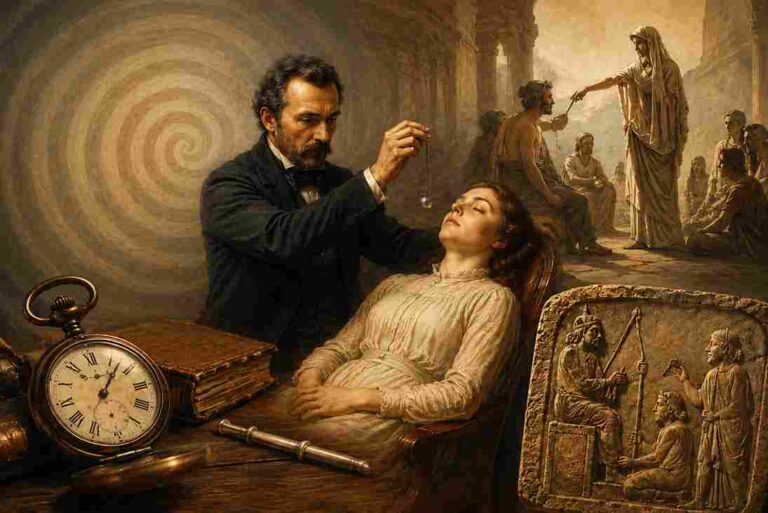
Hypnosis has a much longer and more interesting history than most people realize. What began as temple rituals and misunderstood theories about magnetic fluid slowly turned into a legitimate, studied approach to healing the mind and body.
The tools have changed completely, but the underlying idea, that a calm, focused mind is capable of real change, has stayed the same for thousands of years.
No. Stage hypnosis came much later. The earliest uses were tied to healing, religion, and medicine.
Not in a scientific sense. They didn't have the language or research to explain why trance helped, but they clearly recognized that it did.
Not exactly. Mesmer's theory about magnetic fluid was incorrect, but his sessions revealed real effects that later physicians, including James Braid, worked to properly explain.
Modern hypnotherapy is based on psychology rather than religious ritual or unproven physical theories. It's used in a structured, goal focused way, guided by trained practitioners.
It shows that hypnosis isn't a modern gimmick. It's the continuation of something people have relied on for thousands of years, refined over time into a practice supported by research.