
- August 30, 2026
- 3:39 pm
Hypnotherapy for Stress Reduction: A Practical Approach to Feeling Calmer
Stress is a normal part of life. Deadlines, family responsibilities, financial concerns, health worries, work pressure, and everyday uncertainty can all place demands on the mind and body.
A certain amount of short-term stress can even be useful. It can increase alertness and help us respond quickly when something needs our attention. The difficulty begins when stress feels constant, overwhelming, or difficult to switch off.
For many people, reducing stress is not simply a matter of being told to “relax.” They may understand that they need more rest or a healthier routine while still finding themselves caught in the same patterns of overthinking, tension, poor sleep, or emotional reactions.
This is one reason some people explore hypnotherapy for stress reduction as part of a broader approach to well-being.
Hypnotherapy is not about losing control or being put to sleep. Instead, it generally involves focused attention and increased relaxation while a trained professional guides the individual through suggestions, imagery, and other techniques related to a particular goal.
Used appropriately, it may provide another way to work on how a person responds to everyday pressure.
What Happens When Stress Becomes a Pattern?
Stress does not always begin with a major event. Sometimes it develops through hundreds of smaller experiences. An unanswered email creates tension. Traffic causes frustration. A difficult conversation stays in your thoughts for hours.

You begin worrying about tomorrow while trying to sleep tonight. Over time, these responses can become familiar patterns. A person may automatically tense their shoulders whenever work becomes busy. Someone else may begin checking their phone repeatedly when they feel anxious. Another person may lie awake replaying conversations or worrying about situations that have not happened yet.
The original stressful event may be temporary, but the response can continue long after the event itself has passed. This is where stress management becomes more than simply removing stressful situations.
Most people cannot remove every deadline, responsibility, difficult person, or unexpected problem from their lives. Instead, part of managing stress involves learning to respond differently when those situations occur.
What Is Hypnotherapy?
Hypnotherapy uses hypnosis within a goal-oriented therapeutic setting. During hypnosis, a person typically enters a state of concentrated attention accompanied by relaxation. They remain aware and are not simply unconscious or asleep.
Mayo Clinic describes hypnosis as a state involving increased relaxation and focused concentration, often guided through verbal repetition and mental imagery. That focused state can be used to explore thoughts, mental imagery, habits, reactions, and suggestions connected to a person’s goals.
For stress reduction, a session might focus on areas such as:
- creating a greater sense of physical relaxation,
- recognizing stressful thoughts without automatically following them,
- changing habitual responses to common triggers,
- developing calmer mental associations,
- strengthening feelings of confidence or control,
- practicing mental imagery connected with relaxation,
- or reinforcing healthier routines.
The exact approach can vary depending on the individual and the professional providing the session.
Ready to Reclaim Your Calm?
Take the first step toward deeper confidence, clarity, and emotional balance. Book your hypnotherapy session today and begin creating lasting change from within, one calm breath at a time now.
How Hypnotherapy May Support Stress Reduction
Hypnotherapy should not be viewed as a magical way to eliminate all stress. A more useful way to understand it is as a technique that may help some people work with their patterns of attention, relaxation, thought, and response.
The National Center for Complementary and Integrative Health includes hypnotherapy among several mind-body approaches that may be useful for managing symptoms of stress, although research results vary depending on the condition and application.
There are several ways this approach may be relevant to stress management.
1. Encouraging Deep Relaxation
When people live with persistent pressure, they may become so accustomed to tension that they barely notice it. Their jaws are tight. Their breathing is shallow. Their shoulders remain raised. Their thoughts continually move from one concern to another.
The relaxation component of hypnosis can provide an opportunity to deliberately slow down and focus attention away from everyday distractions. Even the experience of practicing relaxation can help some people become more aware of the difference between a tense state and a calmer one.
2. Identifying Automatic Stress Responses
Stressful reactions can become surprisingly automatic. Imagine receiving a work notification late in the evening. Before consciously thinking about it, you may feel your stomach tighten and immediately start worrying about what the message contains.
Another person may respond to stress by overeating, smoking, avoiding responsibilities, becoming irritable, or spending hours scrolling through social media.
Recognizing the connection between a trigger and an automatic response is an important step toward changing the pattern. Hypnotherapy sessions can be structured around those specific goals rather than attempting to address “stress” as one vague problem.
3. Shifting Attention Away From Repetitive Thoughts
One feature of stress is the tendency to mentally revisit the same issue.
“What if something goes wrong?”
“What should I have said?”
“What if I cannot finish everything?”
“What will happen tomorrow?”
Thinking about a problem can be useful when it leads to a practical solution. Repeating the same worry without reaching a solution is different. Because hypnosis involves focused attention, some people use hypnotherapy as a way of practicing a different relationship with distracting or repetitive thought patterns.
The goal is not necessarily to prevent every stressful thought from appearing. Instead, it may be to become better at noticing the thought without allowing it to dominate the rest of the day.
Hypnotherapy and Everyday Stress Management
One mistake people sometimes make is looking for a single technique that will solve every source of stress. Stress reduction generally works better when several healthy practices support one another. Hypnotherapy can potentially be one part of that broader routine.
For example, someone working on stress reduction might combine professional support with:
- regular physical activity,
- more consistent sleep,
- realistic work boundaries,
- relaxation or breathing exercises,
- time away from screens,
- healthier eating habits,
- social connection,
- mindfulness practices,
- or better organization of daily responsibilities.
Someone interested in exploring this approach can learn more about professional hypnotherapy support and the types of personal goals that may be addressed through individualized sessions.
The important point is that hypnotherapy does not have to replace sensible daily habits. It may instead complement them.

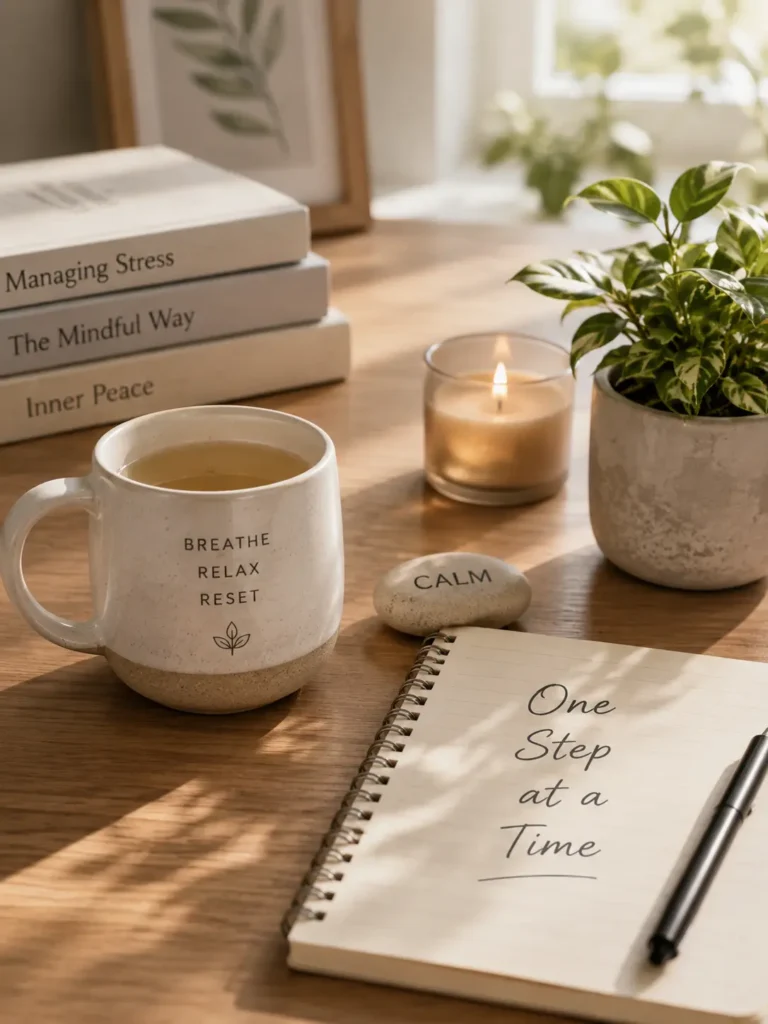
Simple Ways to Support a Calmer Mind
Whether or not you choose hypnotherapy, small changes can make stress management easier. Start by identifying your most common triggers.
Instead of simply saying, “I am stressed,” ask: When does my stress usually increase? Is it first thing in the morning? Before meetings? After checking email? When thinking about money? At bedtime?
Once you recognize the pattern, you can begin testing specific changes. If emails create stress late at night, create a cutoff time. If mornings feel rushed, prepare more the evening before.
If you notice physical tension during the workday, schedule short breaks to stand, stretch, or breathe slowly. If your thoughts become busiest at bedtime, create a consistent period to wind down before trying to sleep. Small adjustments are often easier to maintain than completely redesigning your lifestyle.
Final Thoughts
Stress will always be part of life in some form.
The goal is not necessarily to create a life in which nothing difficult ever happens. A more realistic goal is learning how to experience pressure without allowing every stressful situation to control your thoughts, behavior, and well-being.
Hypnotherapy for stress reduction offers one approach that some people may find useful for practicing relaxation, identifying habitual responses, and working toward healthier ways of managing everyday pressure.
( DO YOU HAVE QUESTIONS )
Common Questions About Hypnotherapy
No. Although people may feel deeply relaxed during hypnosis, they are generally awake and aware of what is happening.
Hypnotherapy is a cooperative process. The individual participates voluntarily rather than surrendering complete control to the practitioner.
There is no universal timeline. Goals, individual responsiveness, circumstances, and the nature of the problem can all influence results.
Stress is a normal human response, so completely eliminating it is neither realistic nor necessarily desirable. The objective is usually to improve how stress is managed and how someone responds to stressful situations.
It should not automatically be considered a replacement for necessary medical or mental health care. Depending on the situation, it may be used as a complementary approach alongside other appropriate support.