
If you’ve tried to quit before, you already know the frustrating part isn’t understanding why you should stop. Everyone knows smoking is bad for them. The hard part is the moment your hand reaches for a cigarette before your brain even catches up, or the way a stressful phone call makes you crave one without you consciously deciding to.
That’s usually where hypnotherapy gets brought up. Someone mentions it worked for a friend, or you come across it while researching quit methods, and the obvious question follows: does it actually work, or is this wishful thinking dressed up as therapy?
The honest answer is somewhere in the middle, and it’s worth understanding both sides before you book a session or write the idea off.
Quitting smoking is really two separate problems wearing one trench coat. Most people only prepare for one of them.
Nicotine leaves the bloodstream fairly quickly, which is part of why cravings hit so often throughout the day. The physical withdrawal, the irritability, the restlessness, the fog, is uncomfortable but relatively short-lived for most people. It typically peaks within the first few days and eases considerably within a couple of weeks.
This is the part that trips people up long after the physical withdrawal has passed. Smoking gets woven into daily routines and emotional states until the two are hard to separate. Common triggers include:
None of those things are addictive on their own. But after enough repetition, the brain files them under “time for a cigarette,” and that association can outlast the physical addiction by months or years.
This is where a lot of misconceptions creep in, usually from stage hypnosis or movies. Nobody snaps their fingers and erases twenty years of habit in one sitting.
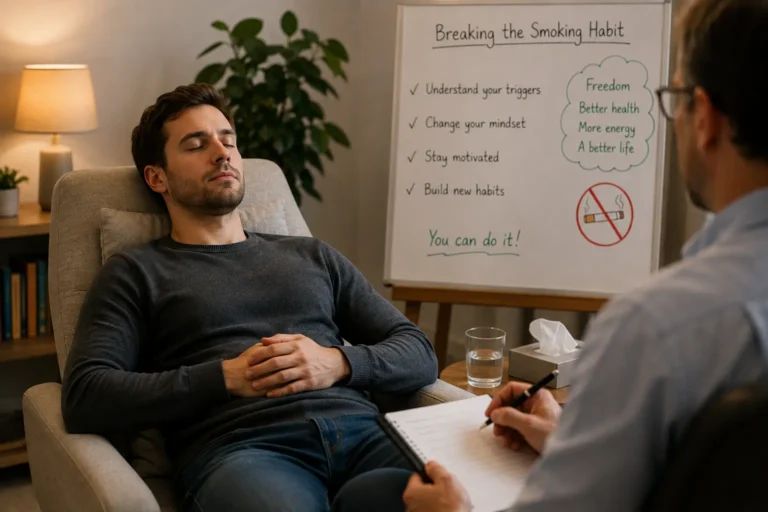
What hypnotherapy is actually trying to do is work with that second problem, the habit loop, by helping you access a more relaxed, focused state where new associations and suggestions can take hold more easily than they would in ordinary conversation. Instead of relying purely on conscious willpower to override a craving in the moment, the goal is to shift some of the automatic responses underneath it.
A typical session usually includes:
You’re not unconscious and you’re not “under someone’s control” during this. Most people describe it as similar to a deeply focused daydream, where you’re relaxed but still aware of what’s happening.
Take the first step toward deeper confidence, clarity, and emotional balance. Book your hypnotherapy session today and begin creating lasting change from within, one calm breath at a time now.
This is worth being straightforward about, because overselling it doesn’t do anyone favors.
Large evidence reviews on smoking cessation methods, including a well-known Cochrane review that has looked at hypnotherapy trials over the years, have generally found the evidence for hypnotherapy to be mixed or inconclusive compared to more heavily studied options like nicotine replacement therapy or prescription medication. Many of the available trials are small, and study quality varies a lot from one to the next.
That’s not the whole picture, though. A more recent systematic review published in 2025 looked at dozens of hypnotherapy studies and found that roughly two-thirds reported a positive effect on quitting, with better results tending to show up in studies that used longer treatment and more sessions rather than a single quick fix. Separately, a 2019 research review estimated that self-hypnosis approaches were associated with six-month quit rates somewhere in the 20 to 35 percent range, which is a meaningful number even though it’s not a guarantee.
Where hypnotherapy seems to show up most consistently in the research isn’t necessarily getting someone to quit on day one. It’s helping people who have already stopped stay stopped, by addressing the trigger-based cravings that cause relapse weeks or months later.
|
Method |
How It Works |
What It Tends to Help Most With |
|
Nicotine replacement (patches, gum, lozenges) |
Reduces physical withdrawal by supplying controlled nicotine |
The physical cravings in the first days and weeks |
|
Prescription medication |
Alters nicotine receptor response or cravings |
Both physical withdrawal and urge intensity |
|
Cold turkey |
Stopping all at once with no aid |
People with strong motivation and few environmental triggers |
|
Counseling or behavioral therapy |
Builds coping strategies and addresses underlying patterns |
Stress-related smoking and long-term relapse prevention |
|
Hypnotherapy |
Works with subconscious associations and automatic triggers |
Habit-based cravings and staying smoke-free after quitting |
Most people who succeed long term don’t rely on just one column. It’s common to pair hypnotherapy with nicotine replacement in the early days, for example, so the physical and mental sides are both being addressed at the same time.
This varies by person and by practitioner, but a few things generally hold true:
Hypnotherapy tends to be a better fit for some situations than others.
It may be worth trying if:
It may be less of a fit, or worth combining with something else, if:
None of that means hypnotherapy won’t work for you specifically. It means going in with realistic expectations, and treating it as one tool rather than a magic switch, tends to lead to better outcomes.


Quitting smoking is rarely about one clean decision. It’s usually a series of smaller moments, the drive home, the after-dinner routine, the stressful afternoon, where the old habit tries to reassert itself. Hypnotherapy won’t remove those moments from your life, but for a lot of people, it changes how automatic the response feels, which is often exactly the gap that willpower alone struggles to close.
If you’re curious whether this approach fits your situation, a short conversation is usually enough to find out. Book a session or reach out with questions before committing to anything.
It can help, particularly with the habit-based cravings that cause relapse, but results vary by person. It's generally more effective as part of a broader plan than as a stand-alone guarantee.
For some people, yes. Most people do better with a short series of sessions, especially with follow-up support during the first few high-risk weeks after quitting.
No. Most people describe it as a relaxed, focused state, similar to being absorbed in a book or a daydream. You remain aware of what's happening throughout.
For most people, yes. It's a low-risk, non-medication approach, though it isn't a substitute for medical care if you have significant nicotine dependence or underlying health conditions worth discussing with a doctor first.
Yes, and it often is. Many people use hypnotherapy to address the mental and habit side of smoking while using another method for the physical withdrawal.
Look for board certification, such as through the National Guild of Hypnotists, and relevant clinical licensing where applicable. Ask how sessions are personalized to your specific triggers rather than run from a generic script.