
If you picture the background of hypnotherapy and immediately think of a stage performer swinging a pocket watch and telling volunteers to cluck like a chicken, you’re not alone. And you’re also working with a pretty skewed picture. Real hypnotherapy has almost nothing to do with that image. It’s a quiet, focused conversation between a trained practitioner and a client, aimed at helping the mind let go of habits, fears, or patterns that logic alone hasn’t been able to shift.
But how did we get from ancient healing rituals to a licensed therapeutic practice used for everything from smoking cessation to anxiety? The story is longer, stranger, and more scientific than most people expect. Understanding it actually helps explain why hypnotherapy works the way it does today.
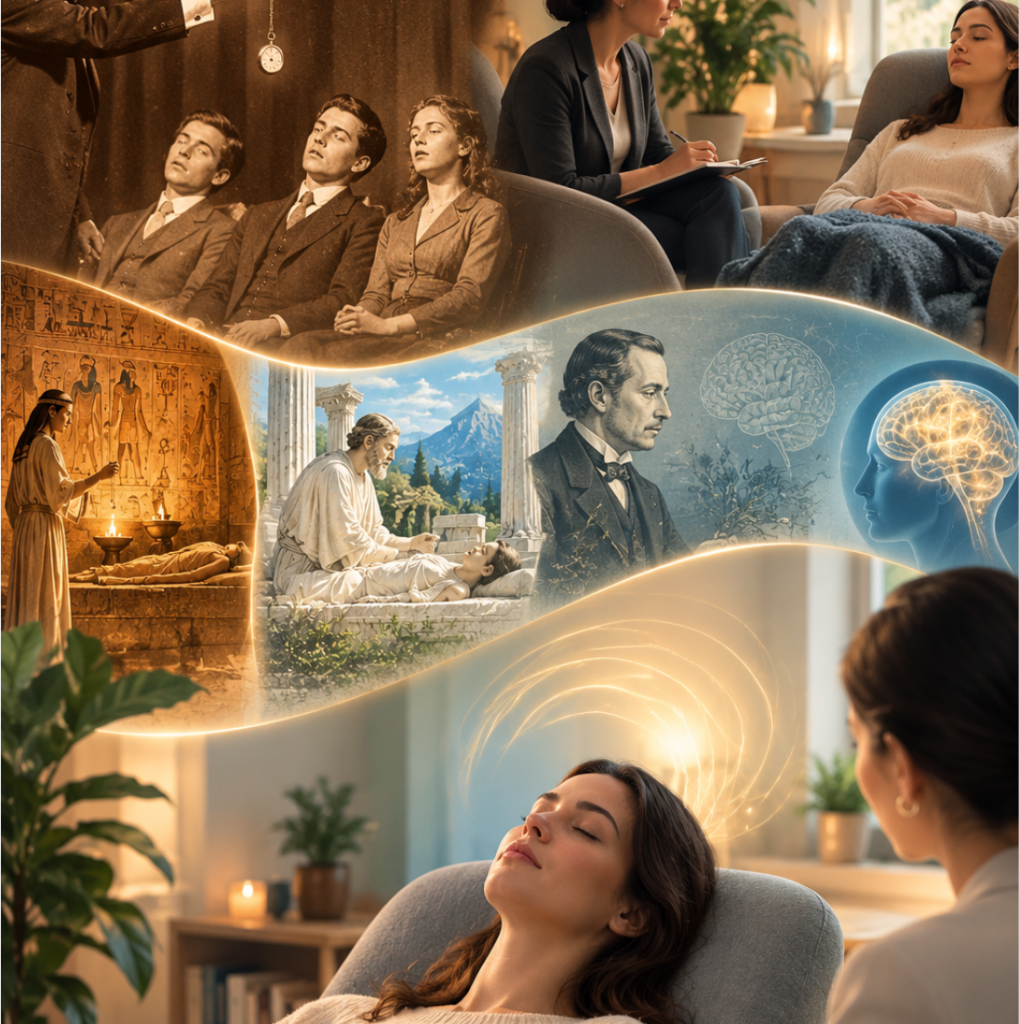

Long before anyone called it “hypnosis,” people were using trance-like states to heal. Historians point to a few early examples:
None of this looked like modern hypnotherapy, but the underlying idea was already there: the mind, when calmed and focused, can influence the body and behavior in ways ordinary waking thought can’t.
Take the first step toward deeper confidence, clarity, and emotional balance. Book your hypnotherapy session today and begin creating lasting change from within, one calm breath at a time now.
The story most people trace hypnotherapy back to starts in 18th-century Vienna, with a physician named Franz Anton Mesmer.
Mesmer believed the human body contained an invisible fluid he called “animal magnetism,” and that illness happened when this fluid became blocked. His treatment involved dramatic sessions, dim rooms, magnets, and elaborate rituals during which patients often fell into trance- like states and reported real relief from their symptoms.
Mesmer’s theory itself didn’t hold up. In 1784, King Louis XVI of France assembled a royal commission which included Benjamin Franklin to investigate his claims. The commission concluded there was no scientific evidence for “animal magnetism” as a physical fluid.
Here’s the interesting twist, though: while the theory was rejected, something real was clearly happening to Mesmer’s patients. That unexplained effect is what later researchers would spend the next century trying to understand and it’s where the word “mesmerize” comes from.
In the 1840s, a Scottish surgeon named James Braid took a serious look at what Mesmer’s patients were experiencing. He rejected the “magnetic fluid” idea entirely and proposed something closer to the modern understanding: this was a psychological and physiological state, not a magical one.
Braid coined the term “hypnosis,” borrowing from hypnosis, the Greek word for sleep, though he later admitted the name was slightly misleading, since hypnosis isn’t actually sleep at all. By this point, the field had shifted from mysticism toward something that could be studied and tested, which set the stage for the next major leap.
By the late 1800s, hypnosis had become a serious subject of medical debate in France, largely split between two schools of thought:
A young neurologist named Sigmund Freud actually studied under Charcot and later visited Bernheim. Freud used hypnosis early in his career to help patients access repressed memories, before eventually moving toward free association and psychoanalysis instead. His departure from hypnosis, ironically, caused the technique to lose favor in mainstream psychology for decades even though the Nancy School had it closer to right.
Hypnotherapy might have stayed a historical footnote if not for Milton H. Erickson, an American psychiatrist working through the mid-1900s. Erickson is widely considered the father of modern clinical hypnotherapy, and his approach is still taught today.
What made Erickson different:
His methods are the direct ancestor of the client-centered, conversational style most hypnotherapists including modern practices use today.
By the second half of the 20th century, hypnosis started getting formally recognized by medical bodies:
Today, hypnotherapy sits at an interesting intersection: respected enough to be studied in clinical settings, yet still shadowed by decades of stage-show stereotypes that have little to do with how it’s actually practiced.
|
Period |
Figure |
What Changed |
|
Ancient era |
Egyptian & Greek healers |
Trance-based healing rituals, no formal theory |
|
1770s–80s |
Franz Mesmer |
“Animal magnetism” popularized, later scientifically discredited |
|
1840s |
James Braid 1840s |
Coined “hypnosis”; reframed it as psychological, not magical |
Late 1800s |
Charcot, Bernheim, Freud |
Debated the nature of suggestion; Freud briefly used hypnosis clinically |
|
1900s–1950s |
Milton H. Erickson |
Developed conversational, individualized hypnotherapy |
1955–1958 |
British & American Medical Associations |
Formal medical recognition |
Today |
Licensed hypnotherapists |
Used alongside talk therapy for habits, anxiety, and behavior change |
Hypnotherapy’s history is really a story about an idea that kept getting misunderstood, discarded, and rediscovered from Mesmer’s flawed theory, to Braid’s scientific reframing, to Erickson’s individualized approach that still shapes practice today. What started as a mystical ritual slowly became a legitimate, studied clinical tool, even if pop culture never quite got the memo.
Understanding where hypnotherapy came from makes it a lot easier to see what it actually is now, not magic, not mind control, but a structured way of working with the mind’s own natural capacity for focus and change.
No. Stage hypnosis is entertainment designed for a crowd, using volunteers who are often naturally more suggestible and eager to participate. Hypnotherapy is a private, goal-focused clinical process aimed at helping a specific person work through a specific issue.
Milton H. Erickson is generally credited with shaping the conversational, client-centered approach that most hypnotherapists use today, even though the roots of hypnosis go back much further.
He used it early in his career to help patients recall repressed experiences, but he eventually moved away from it in favor of psychoanalysis. His shift away from the technique is part of why hypnosis lost mainstream credibility for a while afterward.
The British Medical Association recognized it in 1955, followed by the American Medical Association in 1958 — both acknowledging it as a legitimate tool within appropriate clinical settings.
Mostly because of stage shows and movies, which dramatize hypnosis for entertainment. The actual clinical practice looks far more like a calm, guided conversation than anything theatrical.